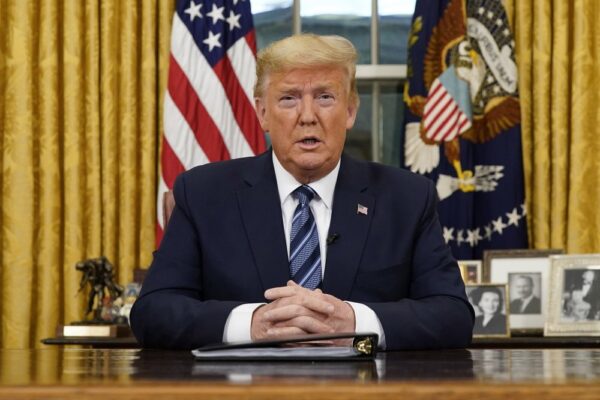
Former President Donald Trump’s made a formal announcement on the rumors he was planning to run for a House of Representatives seat in 2022.
According to the rumors, Trump would be elected Speaker of the House should Republicans retake control of Congress.
That would put him in a prime position to “resist” move from President Joe Biden’s administration — or even become president should Biden and Vice President Kamala Harris both be removed from office.
Trump announced that he won’t seek office or the speaker position, currently held by Rep. Nancy Pelosi, D-Calif.
“Well, I’ve heard the talk and it’s getting more and more,” he said about the rumor Monday.
“But it’s not something that I would’ve considered but it is certainly… there’s a lot of talk about it,” Trump said. “I have a good relationship with [House Minority Leader Kevin McCarthy] and hopefully we will do everything traditionally.”
A spokesman for the 45th president was more direct and confirmed that Trump would not run for Congress and does not want to be Speaker of the House.
“Trump has zero desire to be Speaker,” Jason Miller, a longtime Trump aide, told Punchbowl News.
Even without Trump, Republicans only needing to pick up a handful of seats to regain the House and Senate. Heading towards 2022, the party is eyeing a way to connect policies made in Biden’s Washington with the experiences of voters whose pocketbooks may be feeling the strain.
Their first target: Inflation.
Rep. Jim Banks, R-Ind., said his constituents have “seen the higher prices on gas in particular, but also groceries and the cost to keep their businesses running.” Such voters, he said, “know, intuitively, that this is due to Democrats’ economic agenda and big spending plans.”
Consumer prices rose 5% over the previous 12 months, the largest one-year increase since 2008. Excluding more volatile items such as food and energy, prices were up 3.8% over the past year — the biggest 12-month jump since 1992.
Those leaps were driven by comparisons to the pandemic-hampered 2020 economy, but still show prices climbing sharply, with the cost of used cars rising 7.3% in May and food costs increasing nearly half a percentage point over the same period. Gas prices have risen from a nationwide average of $2.48 to $3.13 per gallon under Biden, the first time since 2014 that it has topped the $3 threshold.
Former Federal Reserve economist Claudia Sahm said this year’s inflation rates are likely to remain far higher than usual, but that’s chiefly due to the pandemic pushing inflation uncommonly low last year.
There’s also a boom in consumer spending due to pent-up demand as the virus recedes and the lingering effects of disruptions to the global supply chain, she said.
Inflation jitters could end up resonating more with voters than many cultural issues Republicans raised in the opening months of Biden’s term.
Florida Sen. Rick Scott, who is leading the GOP effort to retake the Senate, has chided Biden to “realize that reckless spending has consequences, inflation is real and America’s debt crisis is growing.”
Banks, the Indiana congressman who is chairman of the Republican Study Committee, is proposing long shot changes to House rules to mandate that committees report how proposed legislation will affect inflation. “We need to tie inflation to the Biden economic agenda and explain to voters how inflation is Democrats’ hidden tax on the Middle Class,” Banks wrote in a recent memo to the study group’s members.
“It’s here, it’s real,” Louisiana Rep. Steve Scalise, the second-ranking Republican House leader, said of inflation. “And it’s getting worse.”
John Horn, a professor of practice in economics at Washington University in St. Louis, said inflation has occasionally helped influence midterm elections, including when Democrats made congressional gains in 1982 and 2010′s tea party-fueled Republican wave. But it hasn’t played a decisive role in politics since the gas-line-triggering energy crisis of the late 1970s.
“We haven’t dealt with this for 40 years,” Horn said. “Most of the people in that 35 to 65 age range — which is the working class and asking, ‘What’s my wage and can I afford stuff?’ — don’t remember inflation.”
The Associated Press contributed to this article