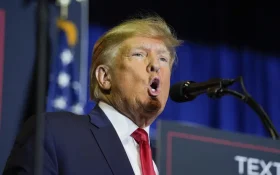
As his Republican rivals gather onstage in California for their second primary debate, former President Donald Trump has other plans.
Trump is in battleground Michigan on Wednesday night working to win over blue-collar voters in the midst of an autoworkers’ strike.
The Republican front-runner’s trip comes a day after President Joe Biden became the first sitting president in U.S. history to walk a picket line as he joined United Auto Workers in Detroit. Critics derided Biden’s photo-op visit, noting he only appeared for 12 minutes and spoke less than 90 seconds.
The dueling appearances preview what will likely be a chief dynamic of the 2024 general election, which is increasingly looking like a rematch between Trump and Biden. Michigan is expected to again be a critical battleground state as both candidates try to paint themselves as champions of the working class.
Trump’s decision to skip another debate comes as he maintains a commanding lead in the GOP primary and as his campaign works to pivot to the general election months before primary voting is set to begin next year.
Trump is scheduled to deliver primetime remarks at Drake Enterprises, an auto parts supplier in Clinton Township, about a half-hour outside Detroit. The company makes automotive and heavy-duty truck components including gear shift levers for semi-trucks, which would be hurt by a shift to electric vehicles, said Nathan Stemple, the company’s president.
His audience will include several hundred current and former UAW members, as well as members of plumbers and pipefitters unions.
Trump has tried to capitalize on the strike to drive a wedge between Biden and union workers, a constituency that helped pave the way for Trump’s 2016 victory. In that election, Trump won over voters in Democratic strongholds like Michigan, Wisconsin, and Pennsylvania, fundamentally reshaping voting alliances as he railed against global trade deals and vowed to resurrect dying manufacturing towns.
But Biden won those states back in 2020 in part because he emphasized his working-class roots and commitment to organized labor. He labels himself the “ most pro-union president” in U.S. history.
Trump, this time around, is seeking to capitalize on discontent over Biden’s handling of the economy amid persistent inflation. He has repeatedly warned Biden’s embrace of electric vehicles — a key component of his green agenda — will ultimately lead to lost jobs, amplifying the concerns of some autoworkers who worry that electric cars require fewer people to manufacture and that there is no guarantee factories that produce them will be unionized.
“Joe Biden’s draconian and indefensible Electric Vehicle mandate will annihilate the U.S. auto industry and cost countless thousands of autoworkers their jobs,” Trump said in a statement after Biden’s Tuesday visit.
While Trump has cast himself as pro-worker, he has clashed repeatedly with union leadership. In a recent campaign video, he urged autoworkers not to pay union dues and claimed their leaders have “got some deals going for themselves.” “I WILL KEEP YOUR JOBS AND MAKE YOU RICH!!!” he has told them.
So far the union has withheld its support for Biden after endorsing him in 2020, though UAW President Shawn Fain appeared at Biden’s side during his visit Tuesday.
Aides say Trump will use his speech to lambast Biden’s economic policies, arguing that middle- and working-class families have suffered under Biden’s presidency. He will also highlight Biden’s record supporting free trade deals, which Trump has blamed for shifting jobs overseas.
“Anyone who’s a working, middle-class voter in Michigan and all around the country is feeling the direct impacts of Biden’s terrible economic policies,” said Trump senior adviser Jason Miller.
Trump has not weighed on the union’s proposal, but aides insist its rank-and-file members “are in a much different place than their political leaders.”
The UAW’s targeted strikes against the Big Three automakers — General Motors, Stellantis and Ford — began at midnight on Sept. 14 and have since expanded to 38 parts distribution centers in 20 states.
The union is asking for 36% raises in general pay over four years and has also demanded a 32-hour week with 40 hours of pay and a return of cost-of-living pay raises, among other benefits. It also wants to be allowed to represent workers at 10 electric vehicle battery factories, most of which are being built by joint ventures between automakers and South Korean battery makers.
While Biden has not implemented an electric vehicle mandate, he has set a goal that half of all new vehicle sales be electric by 2030.
His administration has also proposed stiff new automobile limits that would require up to two-thirds of new vehicles sold in the U.S. to be electric by 2032, a nearly tenfold increase over current electric vehicle sales. That proposal is not yet final.
The Horn editorial team and the Associated Press contributed to this article