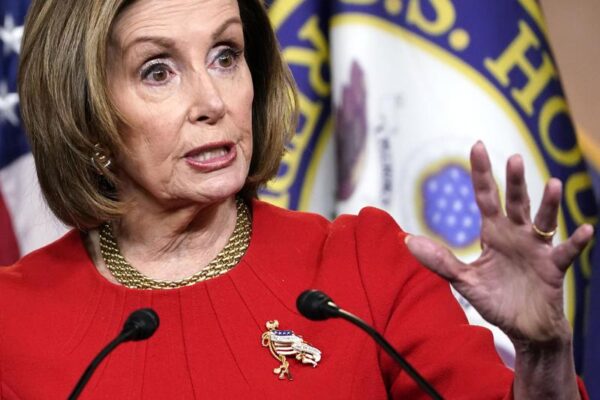
On Thursday, House Speaker Nancy Pelosi, D-Calif., testified at the Congressional-Executive Commission on China (CECC).
Pelosi spoke at a hearing called “Beijing Olympics and the Faces of Repression,” and she urged the Olympic athletes to avoid protesting the human rights violations perpetuated by the People’s Republic of China (PRC) and their communist regime. She told Americans to keep quiet or they risk putting their families in harm’s way by protesting.
“You’re there to compete. Do not risk incurring the anger of the Chinese government, because they are ruthless,” Pelosi said.
She clarified, “I know there is a temptation on the part of some to speak out while they are there. I respect that, but I also worry about what the Chinese government might do: to their reputations, to their families. So again, participate. Let us celebrate from abroad and don’t risk thinking that there are any good intentions on the part of the… People’s Republic of China government, because there are none.”
Some athletes have indeed worried about legal action from PRC. More than 20 athletes have contacted Human Rights Watch to discuss China’s lack of free speech.
“A lot of people who have either never been to China before or who have but aren’t sure about the circumstances or the environment have reached out with questions about what they can say or do, what they’re concerned about, what the authorities’ reactions might be,” Sophie Richardson, China director at Human Rights Watch, told The New York Times on Friday.
In the event of a protest, the athletes may face retaliation not only from PRC, but also the International Olympic Committee (IOC). During the 2014 Olympics in Russia, some Ukrainian athletes famously planned to wear black armbands commemorating police officers’ deaths in Kiev, but the IOC banned them from displaying the armbands in Russia.
“[One protestor] explicitly had said that she would demonstrate in a venue and clearly venues are not the place where we would like to have political demonstration,” IOC spokesperson Mark Adams told The Guardian at the time.
Instead of in-game protests against communist China’s ruling party, Pelosi has endorsed a diplomatic boycott.
That is, she wants American diplomats to stay out of China during the games because of “a genocide that is ongoing while you’re sitting there in your seats.”
“Honor your athletes at home. Let’s have a diplomatic boycott if, in fact, this Olympics takes place,” Pelosi told the CECC in 2019. “Silence is inexcusable.”
On Thursday, Pelosi reiterated her support for a diplomatic boycott.
She said, “Make no mistake, our athletes should participate. They’ve trained. They’re disciplined. They’ve dreamed. They’ve aspired. They’ve worked hard. But this year, we must celebrate them from home, as they compete in China.”
Pelosi stopped short of endorsing a full boycott in the style of the Cold War. In 1980, the U.S. refused to compete in the Moscow Olympics, and in 1984, some Soviet countries refused to compete in the Los Angeles Olympics. Instead, Pelosi is only encouraging American diplomats to stay away from the stands.
Still, Pelosi claimed she was committed to promoting human rights for the people of China. She touted the recent Uyghur Forced Labor Prevention Act. The bipartisan bill raises the standard for rebutting accusations of forced labor, and authorizes the president to sanction any foreigner knowingly relying on Uyghur slavery, and requires companies to disclose all their business dealings in China’s Xinjiang province.
She told the athletes:
While you’re competing, Congress continues to take bipartisan action to defend human rights in China and hold the Chinese government accountable. Most recently, the Uyghur Forced Labor Prevention Act, which was proudly signed into law in December, will harness America’s economic might to make clear: the genocide of Uyghurs must end now.
Pelosi also spoke of renewing the America COMPETES Act, a 2007 bill to fund research, science, and technology.
Now with our America COMPETES Act, which is on the Floor of the House, we will take another strong step to help those who fear for their futures, by designating Uyghurs as prioritized refugees of special humanitarian concern and pursuing a humanitarian pathway for Hong Kongers who feel political persecution.
Is a diplomatic boycott enough?
The Horn News values your response to this urgent poll. Make YOUR voice heard by selecting your answer below:
The Horn editorial team