Stocks slumped on Wall Street Monday in a broad sell-off that extends an already weak streak for major indexes.
Worries about debt-engorged Chinese property developers — and the damage they could do to investors worldwide if they default — are rippling across markets.
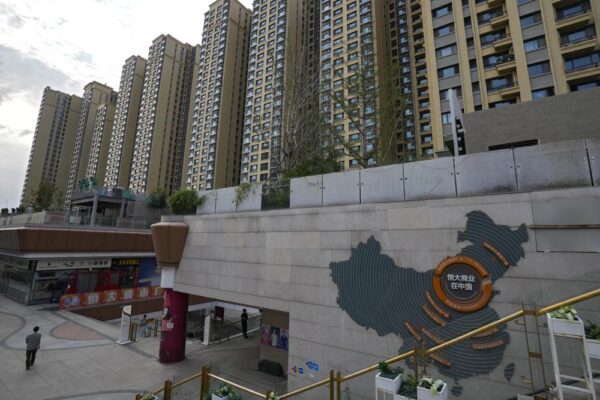
The worries over Chinese property developers and debt recently centers on Evergrande, one of China’s biggest real estate developers, which is struggling to avoid defaulting on billions of dollars of debt, prompting concern about a broader economic fallout and protests by buyers of unfinished apartments.
Evergrande Group appears likely to be unable to repay all of the 572 billion yuan ($89 billion) it owes banks and other bondholders, financial rating agencies say.
Evergrande ran into a cash crunch after its borrowing to build apartments, office towers, and shopping malls collided with pressure from the ruling Communist Party to reduce corporate debt loads that are seen as a threat to the economy.
Beijing has made reducing financial risk a priority since 2018. In 2014, authorities allowed the first corporate bond default since the 1949 communist revolution. Defaults have gradually been allowed to increase in hopes of forcing borrowers and investors to be more disciplined.
Despite that, total corporate, government, and household debt rose from the equivalent of 270% of annual economic output in 2018 to nearly 300% last year, unusually high for a middle-income country. Economists say a financial crisis is unlikely but debt could drag on economic growth by diverting money from consumption and investment.
Evergrande’s struggle has prompted warnings abroad that a broader financial squeeze on real estate — an industry that propelled China’s explosive 1998-2008 boom — could lead to trouble for banks and an abrupt and politically dangerous collapse in economic growth.
The government has yet to say what it might do about Evergrande, one of China’s biggest private sector conglomerates, but financial analysts say Beijing is likely to intervene, especially to protect households that bought unfinished apartments.
An outright default might dent consumer confidence if homebuyers suffer losses, “but we assume the government would act to protect households’ interests, making this outcome unlikely,” Fitch analysts said.
President Xi Jinping is promoting a “common prosperity” initiative to spread China’s wealth more broadly and narrow its politically volatile gap between a wealthy elite and the poor majority. So regulators may favor homebuyers at the expense of banks and other investors in Evergrande debt.
Headquartered in the southern city of Shenzhen, near Hong Kong, Evergrande has sold assets to pay down debt since regulators in August 2020 tightened controls on financing for China’s 12 biggest developers.
The companies were told to limit debt relative to “three red lines” — cash on hand, the value of their assets, and equity in their businesses. Banks are required to limit real estate lending to 40% of their total under rules that took effect in January.
In addition to bondholders, the company owes 667 billion yuan ($103 billion) to construction companies and other business creditors.
Its share price in Hong Kong plunged 34% to an all-time low on Wednesday. It has fallen 50% over the past month.
Evergrande reported a $1.6 billion profit for the first half of 2021. In a statement Tuesday, it said it has hired outside experts in debt restructuring. On Monday, the company denied it would apply for a corporate restructuring under China’s bankruptcy law.
A financial information service, REDD, reported last week, citing unidentified sources, that Evergrande would suspend interest payments on loans to two banks. The company has yet to confirm that.
As of June 30, Evergrande had 240 billion yuan ($37.3 billion) of debt due within a year, down 28.5% from the end of 2020 but nearly triple its cash holdings of 86.8 billion yuan ($13.5 billion), according to a company financial report.
On Sunday, about 100 people who invested in Evergrande debt through “wealth management products” sold by banks crowded into its Shenzhen headquarters to demand repayment.
The company said those investors can choose to be repaid in property, cash in installments, or a claim to payments on residential units, according to the business magazine Caixin.
“It is difficult for Evergrande to make 40 billion yuan ($6.2 billion) of repayments at once for the wealth management products,” the head of Evergrande’s wealth management unit, Du Liang, was quoted as saying.
On Friday, apartment buyers who complain Evergrande suspended construction protested at its headquarters, according to Hong Kong news reports. The company also faces lawsuits by construction contractors that say it has delayed paying them.
Evergrande also sank money into launching its own electric vehicle brand, a priority in the ruling party’s technology plans. It said this week it was making no progress in selling stakes to outside investors.
Other major Chinese developers do not appear to be facing the same cash crunch. But other companies are struggling with debt.
Huarong Asset Management Co., Ltd., the biggest of a group of state-owned companies created to help resolve bad loans held by state banks, reported in August that it lost 102.9 billion yuan ($15.9 billion) last year.
Huarong’s debts stood at $162.3 billion in mid-2020, according to financial information company Capital IQ. However, Huarong said it had no plans to restructure after receiving a capital injection in August from state-owned companies.
Many analysts say they expect China’s government to prevent a blowup serious enough to cause losses to cascade through markets. But any hint of uncertainty may be enough to upset Wall Street, after the S&P 500 has glided higher in almost uninterrupted fashion since October.
The Hang Seng, Hong Kong’s main index, had its biggest loss since July. Many other markets in Asia were closed for holidays. European markets fell about 2%.
“What’s happened here is that the list of risks has finally become too big to ignore,” said Michael Arone, chief investment strategist at State Street Global Advisors. “There’s just a lot of uncertainty at a seasonally challenging time for markets.”
Besides Evergrande, several other worries have been lurking underneath the stock market’s mostly calm surface. The Federal Reserve may soon announce it’s letting off the accelerator on its support for the economy, Congress may opt for a destructive game of chicken before allowing the U.S. Treasury to borrow more money, and the COVID-19 pandemic continues to weigh on the global economy.
Regardless of what the biggest cause for Monday’s market swoon was, some analysts said such a decline was due. The S&P 500 hasn’t had even a 5% drop from a peak since October, and the nearly unstoppable rise has left stocks looking more expensive and with less room for error.
All the concerns have pushed some on Wall Street to predict upcoming drops for stocks. Morgan Stanley strategists said Monday that conditions may be ripening to cause a fall of 20% or more for the S&P 500. They pointed to weakening confidence among shoppers, the potential for higher taxes plus inflation to eat into corporate profits and other signs that the economy’s growth may slow sharply.
Even if the economy can avoid that worse-than-expected slowdown, Morgan Stanley’s Michael Wilson said stocks could nevertheless drop about 10% as the Fed pares back on its support for markets. The Fed is due to deliver its latest economic and interest rate policy update on Wednesday.
Investors will have a chance for a closer look at how the slowdown affected a wide range of companies when the next round of corporate earnings begins in October. Solid earnings have been a key driver for stocks, but supply chain disruptions, higher costs, and other factors could make it more of a struggle for companies to meet high expectations.
“The market’s biggest strength this year could become its biggest risk,” Arone said.
The Associated Press contributed to this article