After three weeks of testimony, the trial of the former police officer charged with killing George Floyd ended swiftly: barely over a day of jury deliberations, then just minutes for the verdicts to be read — guilty, guilty, and guilty — and Derek Chauvin was handcuffed and taken away to prison.
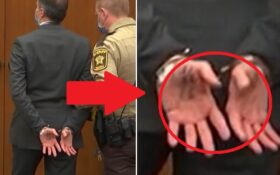
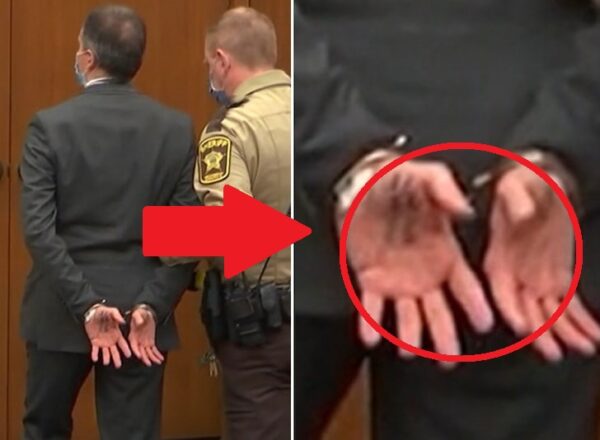
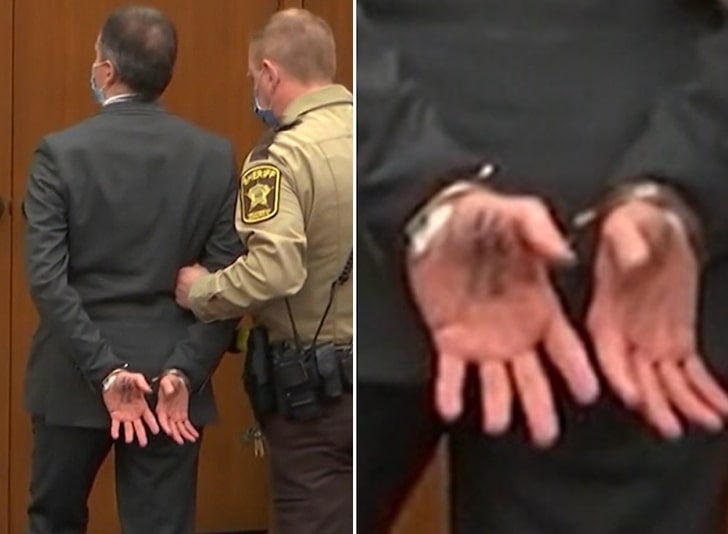
As he was being led away, eagle-eye’d viewers noticed a secret message written on Chauvin’s hand — and the picture went viral.
The message was later confirmed by his legal team to TMZ.com. The photo can be seen below.
Chauvin, 45, could be sent to prison for decades when he is sentenced in about two months in a case that triggered worldwide protests, violence, looting, and a furious reexamination of racism and policing in the U.S.
The verdict set off jubilation mixed with sorrow across the city and around the nation. Hundreds of people poured into the streets of Minneapolis, some running through traffic with banners. Drivers blared their horns in celebration.
“Today, we are able to breathe again,” Floyd’s younger brother Philonise said at a joyous family news conference where tears streamed down his face as he likened Floyd to the 1955 Mississippi lynching victim Emmett Till, except that this time there were cameras around to show the world what happened.
On Wednesday, Philonise Floyd described his thoughts while watching Chauvin being handcuffed. He recalled to ABC’s “Good Morning America” how it appeared “a lot easier” on Chauvin than when his brother was handcuffed before his death, but said it still represented “accountability.”
“It makes us happier knowing that his life, it mattered, and he didn’t die in vain,” he said.
The jury came back with its verdict after just 10 hours of deliberations over two days. The now-fired white officer was found guilty of second-degree unintentional murder, third-degree murder, and second-degree manslaughter.
Chauvin’s face was obscured by a COVID-19 mask, and little reaction could be seen beyond his eyes darting around the courtroom. His bail was immediately revoked and he was immediately led to prison. Sentencing will be in two months; the most serious charge carries up to 40 years in prison.
Defense attorney Eric Nelson followed Chauvin out of the courtroom without comment.
On Chauvin’s hand, a note with Nelson’s number was written in black ink —
President Joe Biden welcomed the verdict, saying Floyd’s death was “a murder in full light of day, and it ripped the blinders off for the whole world” to see systemic racism.
“It’s not enough. We can’t stop here,” he said. “We’re going to deliver real change and reform. We can and we must do more to reduce the likelihood that tragedies like this will ever happen again.”
The verdict was read in a courthouse ringed with concrete barriers and razor wire and patrolled by National Guard troops, in a city on edge against another round of rioting and unrest — not just because of the Chauvin case but because of the deadly police shooting of a young Black man, Daunte Wright, in a Minneapolis suburb April 11.
The jurors’ identities were kept secret and will not be released until the judge decides it is safe to do so.
Floyd, 46, died May 25 after being arrested on suspicion of passing a counterfeit $20 bill for a pack of cigarettes at a corner market. He panicked, pleaded that he was claustrophobic, and struggled against police when they tried to put him in a squad car. They put him on the ground instead.
The centerpiece of the case was the excruciating bystander video of Floyd gasping repeatedly, “I can’t breathe” and onlookers yelling at Chauvin to stop as the officer pressed his knee on or close to Floyd’s neck for what authorities say was 9 1/2 minutes, including several minutes after Floyd’s breathing had stopped and he had no pulse.
Prosecutors played the footage at the earliest opportunity, during opening statements, and told the jury: “Believe your eyes.” From there it was shown over and over, analyzed one frame at a time by witnesses on both sides.
In the wake of Floyd’s death, demonstrations and violence broke out in Minneapolis, around the country and beyond. The furor also led to the removal of Confederate statues and other symbols, such as Aunt Jemima maple syrup, suddenly became controversial.
In the months that followed, numerous states and cities restricted the use of force by police, revamped disciplinary systems, or subjected police departments to closer oversight.
Far-left protesters called for a complete defunding of police departments across the country. Counter-protesters have called for Americans to “Back the Blue.”
Police-procedure experts and law enforcement veterans inside and outside the Minneapolis department, including the chief, testified for the prosecution that Chauvin used excessive force and went against his training.
Medical experts for the prosecution said Floyd died of asphyxia, or lack of oxygen, because his breathing was constricted by the way he was held down on his stomach, his hands cuffed behind him, a knee on his neck and his face jammed against the ground.
Chauvin’s attorney called a police use-of-force expert and a forensic pathologist to try to make the case that Chauvin acted reasonably against a struggling suspect and that Floyd died because of a heart condition and his illegal drug use. Floyd had high blood pressure and narrowed arteries, and fentanyl and methamphetamine were found in his system.
Under the law, police have certain leeway to use force and are judged according to whether their actions were “reasonable” under the circumstances.
The defense also tried to make the case that Chauvin and the other officers were hindered in their duties by what they perceived as a growing, hostile crowd.
Chauvin did not testify, and all that the jury or the public ever heard by way of an explanation from him came from a police body-camera video after an ambulance had taken the 6-foot-4, 223-pound Floyd away. Chauvin told a bystander: “We gotta control this guy ’cause he’s a sizable guy … and it looks like he’s probably on something.”
The prosecution’s case also included tearful testimony from onlookers who said the police kept them back when they protested what was happening.
Frazier, who shot the crucial video, said Chauvin gave the bystanders a “cold” and “heartless” stare. She and others said they felt a sense of helplessness and lingering guilt from witnessing Floyd’s slow-motion death.
“It’s been nights I stayed up, apologizing and apologizing to George Floyd for not doing more, and not physically interacting and not saving his life,” she testified.
.
READ MORE: Maxine Waters flub gives Derrick Chauvin appeal
.
The Associated Press contributed to this article