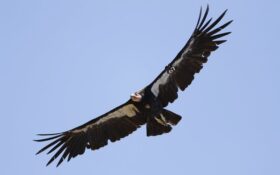
The endangered California condor could return to the Pacific Northwest for the first time in 100 years.
The U.S. Fish and Wildlife Service plans to allow the release of captive-bred giant vultures into Redwood National Park as early as this fall to create a “nonessential experimental population” for California’s far north, Oregon and northwestern Nevada, the San Francisco Chronicle reported Wednesday.
The project will be headed by the Yurok tribe, which traditionally has considered the California condor a sacred animal and has been working for years to return the species to the tribe’s ancestral territory.
“Certainly within a year we hope to have birds in the sky,” Tiana Williams-Claussen, director of the wildlife department of the Yurok tribe, told the Chronicle.
“Not having him here for 100 years now, we as a people are wounded without having that spirit flying in our skies,” she said.
The California condor is the largest native North American bird, with a wingspan of nearly 10 feet (3 meters). The scavenger was once widespread but had virtually disappeared by the 1970s because of poaching, lead poisoning from eating animals killed by hunters and destruction of its habitat.
In the early 1980s, all 22 condors remaining in the wild were trapped and brought into a captive-breeding program that began releasing the giant vultures into Southern California’s Los Padres National Forest in 1992. That flock has been expanding its range while other condors now occupy parts of California’s Central Coast, Arizona, Utah and Baja California, Mexico. The total wild population now numbers more than 300 birds.
A dozen adults and two chicks died last summer when a wildfire ravaged their territory in Big Sur, along California’s Central Coast.
The new initiative calls for releasing four or six juvenile condors each year for 20 years throughout Redwood National Park, which is about an hour’s drive from the Oregon border.
Condors can live for 60 years and fly vast distances, which is why their range could extend into several states.
The Associated Press contributed to this article