
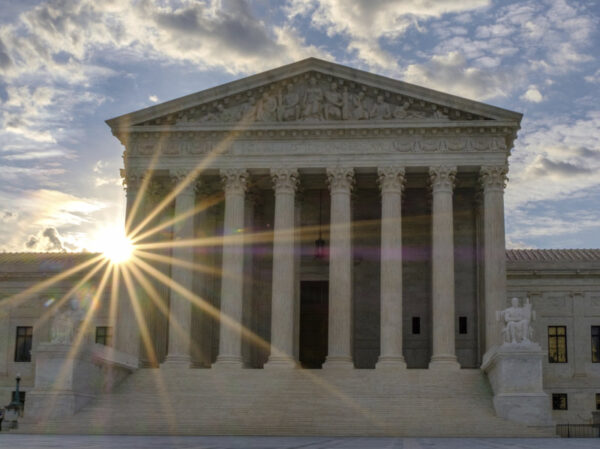
The Texas lawsuit asking the U.S. Supreme Court to invalidate Joe Biden’s current electoral college lead has quickly become a conservative litmus test, as 106 members of Congress and multiple state attorneys general signed onto the case even as some have predicted it will fail.
The Supreme Court is expected to decide the historic case within just days.
And finally, after months of legal wrangling, hearings, and wild press conferences… all eyes are on Texas and their lawsuit.
It’s a last-stand attempt to overturn the results of the Nov. 3 election as they stand, and demonstrates President Donald Trump’s enduring political power. And even though most of the signatories are far-right conservatives who come from deep red districts, the filing meant that roughly one-quarter of the U.S. House believes the Supreme Court should set aside election results.
Seventeen Republican attorneys general are backing the case that Trump is calling “the big one.”
In a filing Thursday, the Congressional Republicans claimed “unconstitutional irregularities” have “cast doubt” on the 2020 outcome and “the integrity of the American system of elections.”
According to Fox News’ Sean Hannity, the lawsuit is an “uphill battle” for conservative lawyers. Election law experts have agreed.
“The Supreme Court is not going to overturn the election in the Texas case, as the President has told them to do,” tweeted Rick Hasen, a law professor at the University of California, Irvine.
The lawsuit filed against Michigan, Georgia, Pennsylvania, and Wisconsin repeats accusations about the voting in four states that went for Trump’s Democratic challenger. The case demands that the high court invalidate the states’ 62 total Electoral College votes. That’s an unprecedented remedy in American history: setting aside the votes of tens of millions of people, under the claim the Republican incumbent lost a chance at a second term due to widespread fraud.
Trump’s own legal team, led by former New York City Mayor Rudy Giuliani, repeatedly failed in their own court attempts, much to the frustration of Trump loyalists.
Giuliani refused to submit much of the evidence he claims to have uncovered to the courts, opting instead to hold unofficial hearings in front of Republican state representatives and make appearances on news programs.
Two days after Paxton sued, 17 states filed a motion supporting the lawsuit, and on Thursday six of those states asked to join the case themselves. Trump has acted to join the case, tweeting Thursday that “the Supreme Court has a chance to save our Country from the greatest Election abuse in the history of the United States.” Hours later, Trump held a meeting at the White House, scheduled before the suit was filed, with a dozen Republican attorneys general, including Paxton and several others who are backing the effort.
Still, some of the top state Republican prosecutors urging the Supreme Court to hear the case have acknowledged that the effort is a long shot and are seeking to distance themselves from Trump’s baseless allegations of fraud. North Dakota’s Wayne Stenehjem, among the 17 attorneys general supporting the case, said North Dakota is not alleging voter fraud in the four states at issue.
“We’re careful on that,” said Stenehjem, who noted that his office has received thousands of calls and emails from constituents asking the state to support the suit. “But it’s worth it for the Supreme Court to weigh in and settle it once and for all,” he said.
Montana Attorney General Tim Fox called the lawsuit “belated” and admitted it was a longshot attempt. But Fox supported Texas because he said the case raised “important constitutional questions about the separation of powers and the integrity of mail-in ballots in those defendant states.”
The litigation rankled Democratic attorneys general. Massachusetts Attorney General Maura Healey called the attempt to overturn votes “unconscionable.” And the support among other leading lawyers was disturbing, Nevada Attorney General Aaron Ford, the co-chair of the Democratic Attorneys General Association, told AP.
“I do think that these individuals are kowtowing to a president who has implemented some level of control and authority over the duly elected attorneys general in their states in a way that is unfortunate,” he said.
Earlier this week, the Supreme Court this week rejected an injunction request by Rep. Mike Kelly, R-P.A., to stop or reverse Pennsylvania’s certification of Biden’s victory.
Trump looked straight past the high court loss, claiming it didn’t matter because his campaign wasn’t involved in the case, though it would have benefited if the case had continued. He has spent the week relentlessly tweeting about the Texas case with the hashtag “overturn” and claiming that he had won the election but was robbed.
Kelly can still file the case after-the-fact. But with time running out until the Electoral College vote next week, the Texas suit remains Trump’s last realistic chance.
Not every Republican is happy. The case stirred Republican infighting in Utah, where GOP Gov. Gary Herbert and Lt. Gov. Spencer Cox, who will become governor in January, blasted Attorney General Sean Reyes for deciding to join the suit.
“The Attorney General did not consult us before signing on to this brief, so we don’t know what his motivation is,” they said in a joint statement. “Just as we would not want other states challenging Utah’s election results, we do not think we should intervene in other states’ elections.”
Despite the political pressure, Idaho’s Republican attorney general chose not to join the Texas suit. Lawrence Wasden said he has concerns about “supporting a legal argument that could result in other states litigating against legal decisions made by Idaho’s legislature and governor.” Idaho’s two congressmen, Republicans Mike Simpson and Russ Fulcher, joined the legal brief from GOP House members supporting Paxton’s effort.
“As is sometimes the case, the legally correct decision may not be the politically convenient decision,” Wasden said in a statement. “But my responsibility is to the state of Idaho and the rule of law.”
But don’t take our word for it.
We want to hear from you.
Will the Texas suit succeed in front of the Supreme Court?
Or is it too much of a longshot?
Vote here —
Do you think the Texas lawsuit will succeed?
Vote here --
The Associated Press contributed to this article