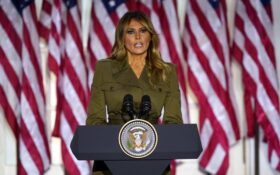
First lady Melania Trump portrayed her husband as an authentic, uncompromising leader in a Rose Garden address as President Donald Trump turned to family, farmers, and the trappings of the presidency to boost his reelection chances on the second night of the scaled-down Republican National Convention.
Mrs. Trump offered a polished portrait of Trump’s presidency Tuesday night, part of a broader effort to show a more forgiving side of a combative president who will soon face the voters. Beyond the first lady’s remarks, Trump pardoned a reformed felon and oversaw a naturalization ceremony for several immigrants in the midst of the program.
“In my husband, you have a president who will not stop fighting for you and your families,” said Mrs. Trump, an immigrant herself. “He will not give up.”
Mrs. Trump and two of the president’s five children led a diverse collection of supporters, including a convicted bank robber, calling for Trump’s reelection on a night that featured a more positive tone than the night before.
Trump may have ground to make up. Many polls report that Democratic rival Joe Biden has an advantage heading towards November’s election.
In a particularly emotional moment, Trump showed a video of himself signing a pardon for Jon Ponder, a man from Nevada who has founded an organization that helps prisoners reintegrate into society.
“We live in a nation of second chances,” Ponder said, standing alongside Trump.
“Jon’s life is a beautiful testament to the power of redemption,” Trump said before he signed the pardon.
The lineup also had a Maine lobsterman, a Wisconsin farmer and a Native American leader. Social conservatives were represented by an anti-abortion activist and Billy Graham’s granddaughter.
The convention also featured a Kentucky high school student whose interaction last year with Native Americans and a group of Black supremacists became a flashpoint in the nation’s culture wars after he was libeled by mainstream media outlets.
With Election Day just 10 weeks off and early voting beginning much sooner, Trump is under increasing pressure to reshape the contours of the campaign. But as a pandemic has swept the globe, Republicans have yet to identify a consistent political message arguing for his reelection.
Mrs. Trump noted that the lives of Americans changed “drastically” in March with the onset of the coronavirus. But other speakers made little mention of the pandemic even as it remains a dominant issue for voters.
The COVID-19 death toll surged past 178,000 on Tuesday, and there is no sign of slowing. Because of the shutdown, the nation’s unemployment rate still exceeds 10%, which is higher than it was during the Great Recession. And more than 100,000 businesses are feared closed forever.
At the same time, the White House seems to have abandoned efforts at another rescue package with Congress after Democratic leaders refused to negotiate.
There were fierce attacks on Biden throughout the night, although the lineup generally maintained a positive tone — in part due to some last-minute changes.
Mary Ann Mendoza, an Arizona woman whose son, a police officer, was killed in 2014 in a car accident involving an immigrant in the country illegally, was pulled from the program minutes before the event began. She had directed her Twitter followers to a series of anti-Semitic, conspiratorial messages.
There were also barrier breakers featured like Kentucky Attorney General Daniel Cameron, the first African American to hold statewide office in Kentucky, and Florida Lt. Gov. Jeanette Nunez, first Latina to hold that office in her state.
And the convention featured a Democrat for the second night: Robert Vlaisavljevich, the mayor of Eveleth, Minnesota, who praised Trump’s support for his state’s mining industry in particular.
“President Trump is fighting for all of us. He delivered the best economy in our history and he will do it again,” Vlaisavljevich said.
Secretary of State Mike Pompeo addressed the convention and the nation during an official overseas trip in Israel.
“President Trump has put his America First vision into action,” Pompeo said. “It may not have made him popular in every foreign capital, but it’s worked.”
Pompeo’s taped appearance broke with decades of tradition of secretaries of state avoiding the appearance of involving themselves in domestic politics. That his video was filmed in Jerusalem, where he was on an official foreign trip, raised additional questions of propriety.
But it was Mrs. Trump that was the show stopper of the night.
Out of the public view for much of the year, she stepped into the spotlight to wide praise.
Only the second foreign-born first lady in U.S. history, Mrs. Trump, 50, is a native of Slovenia, a former communist country in eastern Europe. She became Trump’s third wife in 2005 and gave birth to their now 14-year-old son, Barron, in 2006 — the year she became a naturalized U.S. citizen.
The first lady spoke from the renovated Rose Garden, despite questions about using the White House for a political convention. She addressed an in-person group of around 50 people, including her husband.
“Whether you like it or not, you always know what he’s thinking. And that is because he’s an authentic person who loves this country and its people and wants to continue to make it better,” Mrs. Trump said. “He wants nothing more than for this country to prosper and he doesn’t waste time playing politics.”
Melania Trump on coming to America and becoming a citizen: "It is still one of the proudest moments in my life, because with hard work and determination I was able to achieve my own American dream." pic.twitter.com/BeTHEvsEFT
— Axios (@axios) August 26, 2020
The Associated Press contributed to this article