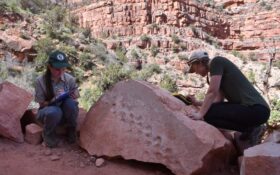
It’s something like a modern-day chuckwalla, side-stepping sand dunes on an island in what now is Grand Canyon National Park.
That’s how Steve Rowland, a professor emeritus of geology at the University of Nevada, Las Vegas, interprets fossil footprints that were revealed in a rock fall near a popular Grand Canyon hiking trail. He estimates they’re 313 million years old, give or take a half-million years.
At that age, they’d be among the oldest tracks of animals that lay hard-shell eggs and the earliest evidence of vertebrate animals strolling in sand dunes, he wrote a research paper published this month.
“I think my interpretations will hold up very well,” Rowland said Monday.
Not everyone is convinced the footprints were created by a single, four-legged animal, moving laterally one step at a time so that it always had a triangle of support. (Dogs or camels have the same gait in slow motion). Or, that the footprints mark the point in evolution where animals were able to lay hard-shell eggs. Those animals are called amniotes.
Still, the paper raises interesting questions, said Mark Nebel, the paleontology program manager at the Grand Canyon.
“Some of the conclusions likely are going to be controversial,” he said. ”There’s a lot of disagreement in the scientific community about interpreting tracks, interpreting the age of rocks, especially interpreting what kind of animal made these tracks.”
Rowland first heard about the footprints from a Norwegian geology professor, Allan Krill, who was hiking at the Grand Canyon in 2016 with his students and sent Rowland a photo.
Rowland made out claw marks common among reptiles in the 28 footprints, which he said help tease out scarce skeletal record. Some of the earliest bones of amniotes were found in Nova Scotia around the same time the creatures would have been in what’s now northern Arizona, Rowland said.
Similar tracks elsewhere largely are found in coal beds, not sand dunes, he said.
“You could always learn more, and we certainly would like to find more tracks of those same animals,” he said.
The rock fell from the Manakacha Formation, made up of sandstone, limestone and mudstone that points to it being a onetime coastal plain when Arizona was on the western edge of the super continent, Pangaea. Dinosaurs weren’t around yet.
Officials at the Grand Canyon are trying to determine what to do with the rock that weighs hundreds of pounds and is in plain view along the Bright Angel Trail. Another part of the rock also has footprints but wasn’t studied extensively.
The Grand Canyon has talked about creating a trail-side display or flying the rock out and into a museum, which would be costlier, Nebel said.
“A lot of people walk by it and never see it,” he said. “Scientists, we have trained eyes. Now that they know something’s there, it will draw more interest.”
The Associated Press contributed to this article