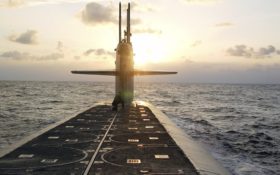
A senior Russian diplomat raised concern Wednesday about the United States deploying a new submarine-launched nuclear weapon, saying the move signaled Washington’s belief that it could wage a limited nuclear conflict.
The Pentagon’s top policy official told The Associated Press this week that a a nuclear warhead of reduced destructive power had been fitted onto a Trident II intercontinental ballistic missiles carried by nuclear submarines.
John Rood, the undersecretary of defense for policy, said the deployment of the so-called low-yield warheads lowers the risk of nuclear war by helping dissuade Russia from initiating a limited nuclear conflict.
Moscow has rejected U.S. allegations that Russia was considering such a conflict. The Russian government long has criticized the Pentagon’s plans to develop low-yield nuclear weapons, arguing that a limited nuclear conflict would inevitably escalate into a full-blown nuclear war.
Russian Deputy Foreign Minister Sergei Ryabkov said Wednesday that the new missile’s deployment is an indication the United States views a low-intensity nuclear conflict as a feasible option. He described the U.S. move as “very alarming.”
“It’s a reflection of the fact that the U.S. lowers the nuclear threshold and considers it possible to wage a limited nuclear war and win such a war,” Ryabkov said in remarks carried by Russian news agencies.
He accused Washington of stonewalling on Moscow’s 2018 proposal to reaffirm a joint statement by U.S. President Ronald Reagan and Soviet leader Mikhail Gorbachev in 1985 that said “a nuclear war cannot be won and must never be fought.”
Ryabkov said the U.S. was at risk of what he described as a “drift in the dangerous direction, a slide toward planning absolutely unacceptable catastrophic scenarios.”
Last year, Russia and the U.S. both withdrew from the 1987 Intermediate-range Nuclear Forces (INF) Treaty. The U.S. said it pulled out because of Russian violations; the Kremlin denied breaching the treaty’s terms.
The Kremlin has said that Washington also appears reluctant to extend the New START treaty, the last remaining arms control deal between Russia and the U.S., which expires in 2021.
The Associated Press contributed to this article