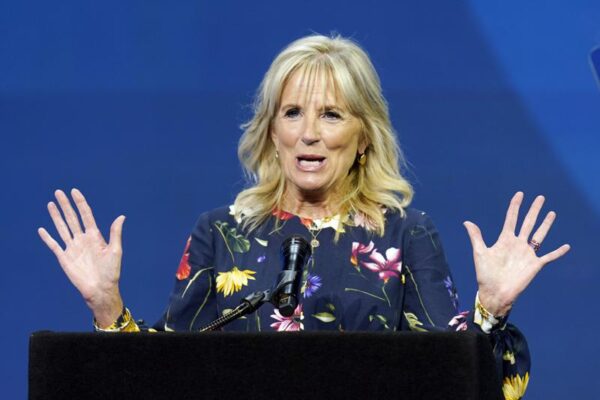
Former first lady Jill Biden’s revenge tour against her former political allies and White House staff has reached a volatile level.
Last month, Jill Biden sat down with “The View” co-host Whoopi Goldberg to promote her memoir, “A View from the East Wing,” and to discuss her life, politics, and media.
Footage of the forum has now surfaced, and it appears that Jill Biden feels like her husband, Joe, was subject to a double standard.
Biden was asked about how the press covered her husband’s presidential term, and she didn’t hold back.
Goldberg, who moderated the 92nd Street Y event in New York City last month, asked whether the former first lady believes the press covered former President Joe Biden’s four years in office fairly.
Biden said, “You know, I think probably, well, I mean, seeing how things are now, I don’t know. I don’t know. I’d have to think about that.”
Biden suggested there was a “double standard” between coverage of the Biden administration and the current Trump administration.
“You know, if Joe would have done any one of the things that are occurring now, I mean he would have been excoriated,” she said.
Goldberg said while chuckling, “Oh yeah.”
Biden continued, “But, you know, it’s just there — it’s like there’s a double standard. And that I don’t think is fair or was fair.”
Take a listen —
JILL BIDEN ADMITS: "Double Standard" Protected Joe
Jill Biden admits there was a massive "double standard" protecting Joe — and says if he did "any one of the things occurring now" the press would've "excoriated" him!
She regrets not cozying up more to reporters: "Maybe we… pic.twitter.com/yZaNLpdEwN
— Mr Producer (@RichSementa) July 16, 2026
Biden’s claim comes after reports surfaced that many mainstream media outlets went out of their way to help hide Joe Biden’s rapid cognitive decline.
Biden, however, then went on to suggest that her husband’s administration could have done more to form stronger relationships with the media.
“But, you know, maybe we could have done more to reach out to the press to be more open so that they understood us as real people and not sort of these figureheads. That’s one thing I do regret, that maybe we could have formed closer relationships.”
Biden also pushed back on Democratic critics of her memoir who have said the book needlessly dug up controversies from the 2024 election.
During a Washington, D.C., book event in early June, Biden was asked specifically about comments from former Biden White House spokesman Andrew Bates, who said of her book, “I don’t see why that painful conversation for the party needed to be publicly reopened right now,” according to the New York Post.
“I want to say to Andrew: Call me up, and say it to my face, buddy,” Biden responded, arguing that her book had only “one chapter on politics.”
And speaking of Biden’s book, it debuted at #1 on the New York Times Hardcover Nonfiction bestseller list on June 21.
However, just a short time later, it plummeted from the top spot, with suspicions that she funneled donor cash from Biden’s campaigns into her own pocketbook, as previously reported by The Horn News.
The book arrived with a small but telling symbol next to its #1 ranking: a dagger (†). The Times uses that mark when it has reason to believe a book’s sales numbers were inflated by bulk purchases by large institutions rather than by real Americans going to a bookstore or clicking “buy.” The book slipped to #3 the following week, then dropped off the list entirely.
Even Nate Silver, the Democrat-aligned statistician and former founder of FiveThirtyEight, wasn’t buying it.
“It debuted at #1 on the NYT due to astroturfed bulk orders (not my opinion — it got the infamous † indicating this) and is now completely off the list 2 weeks later,” Silver posted on X. “Very rare for a ‘#1’ to fall that fast. Virtually no one except political reporters are actually reading it.”
The numbers back him up. According to Circana BookScan retail data cited by the New York Post, the book sold just 3,221 print copies in the week ending June 20, and had accumulated a total of 29,539 U.S. print sales — dismal figures for a book that received the kind of blanket media attention most authors can only dream about.