
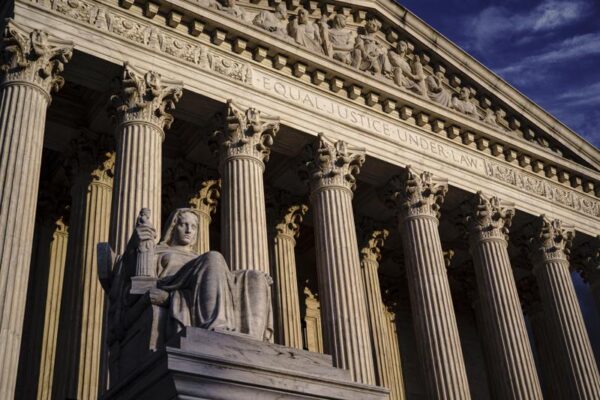
The Supreme Court delivered a decisive victory for women’s sports advocates Tuesday, ruling 6-3 that states have the authority to require athletes to compete according to their biological sex at birth.
The ruling upheld laws in West Virginia and Idaho and has effectively settled one of the most insane questions in the 21st century of American sports: What is a woman?
Becky Pepper-Jackson, a West Virginia high schooler, and Lindsay Hecox, a former Boise State University runner, challenged their states’ laws as unconstitutional sex discrimination. Both were born as men, but want to compete against biological females.
Justice Brett Kavanaugh authored the majority opinion, joined by the court’s other five conservative justices.
“Consistent with Title IX and the Equal Protection Clause, we hold that the States may maintain women’s and girls’ sports for biological females,” Kavanaugh wrote. “They may determine eligibility for women’s and girls’ sports based on biological sex.”
West Virginia’s Save Women’s Sports Act, enacted in 2021, defines a female as a person “whose biological sex determined at birth as female” and bars athletes born male from competing in girls’ and women’s sports.
Idaho’s law similarly states that sports “designated for females, women, or girls should not be open to students of the male sex.” The laws were passed to provide fair and safe competition for female athletes, given the physiological advantages in strength and speed between biological males and females.
“If women don’t have their own competitions, they won’t be able to compete. Gender identity does not matter in sports, and that’s why Idaho’s law does not classify on the basis of gender identity,” Idaho Solicitor General Alan Hurst said during oral arguments. “It treats all males equally and all females equally, regardless of identity.”
Idaho State University runners Madison Kenyon and Mary Marshall, who competed against and were defeated by a transgender athlete in 2019 and early 2020, have come forward about what it meant to lose to a competitor who had gone through male puberty.
“I know it’s not fair, because I stepped on the line and was beat by a male, and saw hundreds of other women be beat by a male,” Kenyon said. Marshall added: “To wake up at 7 a.m. every single day, putting in workouts, running, going to the gym, and then, to go to the race, already knowing the outcome, it’s absolutely deflating.”
Although the ruling formally applies only to West Virginia and Idaho, it is expected to have sweeping national consequences.
Twenty-five other states have similar laws on the books, and Tuesday’s decision effectively ends all legal challenges to all of them.
The decision extends a string of recent defeats for transgender rights advocates at the high court. Last year, the justices upheld a Tennessee law banning sex-changes for minors.
President Donald Trump’s administration had backed the states throughout the litigation, consistent with an executive order Trump signed early in his second term titled “Keeping Men Out of Women’s Sports.”