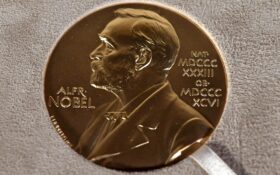
Chinese-American physicist Tsung-Dao Lee, who in 1957 became the second-youngest scientist to receive a Nobel Prize, died Sunday at his home in San Francisco at age 97, according to a Chinese university and a research center.
Lee, whose work advanced the understanding of particle physics, was one of the great masters in the field, according to a joint obituary released Monday by the Tsung-Dao Lee Institute at Shanghai Jiao Tong University and the Beijing-based China Center for Advanced Science and Technology.
Lee, a naturalized U.S. citizen since 1962, was also a professor emeritus at Columbia University in New York.
Robert Oppenheimer, known as the father of the atomic bomb, once praised Lee as one of the most brilliant theoretical physicists of the time, whose work showed “remarkable freshness, versatility and style.”
Lee was born in Shanghai on Nov. 24, 1926, the third of six children to a merchant father, Tsing-Kong Lee, and a mother, Ming-Chang Chang, who was a devout Catholic, according to local newspaper Wenhui Daily.
He went to high school in Shanghai and attended National Chekiang University in Guizhou province and National Southwest Associated University in Kunming in Yunnan province.
After his sophomore year, he received a scholarship from the Chinese government to attend graduate school in the United States.
Between 1946 and 1950, he studied at the University of Chicago under Enrico Fermi, a Nobel laureate in physics.
In the early 1950s, Lee worked at the Yerkes Observatory in Wisconsin, at the University of California at Berkeley and at the Institute for Advanced Study in Princeton, N.J.
His research in elementary particles, statistical mechanics, astrophysics and field theory, among others, was standing out.
In 1953, he joined Columbia University as an assistant professor. Three years later, at age 29, he became the youngest-ever full professor there. He developed a model for studying various quantum phenomena known as the “Lee model.”
In 1957, Lee was awarded the Nobel Prize in physics together with Chen-Ning Yang for work exploring the symmetry of subatomic particles as they interact with the force that holds atoms together. At 31, Lee was the second-youngest scientist to receive the distinction.
He won many other accolades including the Albert Einstein Award in Science, the Galileo Galilei Medal and the G. Bude Medal, as well as honorary doctorates and titles from organizations around the world.
As China became more open to international exchanges in the 1970s, Lee returned to his home country on repeated visits to give lectures and encourage the development of sciences, according to state media.
The Associated Press contributed to this report.