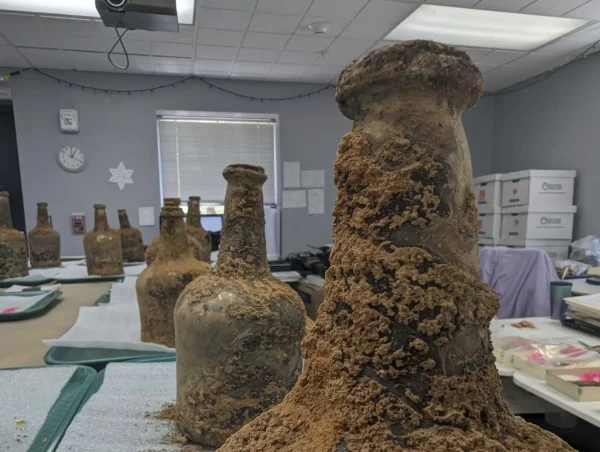
In a remarkable archaeological find, dozens of bottles containing whole cherries, berries and other fruit have been unearthed from the cellar of George Washington’s Mount Vernon estate – perfectly preserved after more than 250 years.
The unprecedented discovery was made during an excavation connected to Mount Vernon’s $40 million mansion revitalization project ahead of America’s 250th birthday in 2026. Archaeologists uncovered a series of storage pits underneath what used to be the mansion’s brick cellar floors, containing 35 bottles filled with fruits and berries preserved since before 1775.
“Finding what is essentially fresh fruit, 250 years later, is pretty spectacular,” said Jason Boroughs, Mount Vernon’s principal archaeologist. “All the stars sort of have to align in the right manner for that to happen.”
Of the 35 bottles found, 29 were intact – 12 containing cherries, 16 filled with what appear to be gooseberries or currants, and one larger bottle holding both cherries and berries. The bottles predate 1775 as that’s when an expansion covered over the area with brick flooring.
The quality of the preservation is a testament to the skilled work of Mount Vernon’s enslaved staff. Records show George and Martha Washington were fond of cherries, with Martha even having a recipe for a “cherry bounce” cocktail. However, these bottles were likely intended for eating the fruit.
“The enslaved folks who were taking care of the trees, picking the fruit, working in the kitchen, those would have been the folks that probably would have overseen and done this process,” Boroughs said. “It’s a highly skilled process. Otherwise, they just wouldn’t have survived this way.”
In addition to marveling at the exceptionally preserved fruit, archaeologists are also examining over 50 cherry pits found in hopes that some may still be viable seeds to grow new trees. Mount Vernon has partnered with the USDA to conduct DNA testing on the fruits as well.
“It’s kind of a longshot,” said USDA plant geneticist Benjamin Gutierrez about germinating the pits. “Seeds preserve best when they are dry, and most of the samples found at Mount Vernon were waterlogged.”
Still, the chance to study ancient fruits and seeds offers exciting insights into the culinary lives and farming practices of early Americans like the founding father who led the Revolutionary War.
“There is a lot of information that we’re excited to get from these bottles,” Boroughs said of the rare archaeological treasure from the home of George Washington.