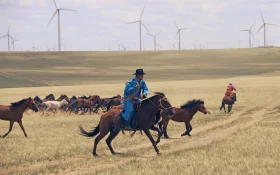
Scientists have made a significant discovery about the history of horse domestication, which has greatly influenced human civilization.
A study published in the journal Nature reveals that around 4,200 years ago, a particular lineage of horse rapidly became dominant across Eurasia, suggesting that humans began to spread domesticated horses around the world at that time.
This specific horse lineage had a genetic mutation that altered the shape of its back, likely making it easier for humans to ride. Before this period, there were many different horse lineages, as evidenced by ancient DNA samples analyzed by researchers from archaeological sites across Eurasia dating back 50,000 years.
However, the analysis of 475 ancient horse genomes showed a remarkable change around 4,200 years ago. A lineage that first emerged in the Pontic-Caspian Steppe, a plains region stretching from northeastern Bulgaria through Ukraine and southern Russia, began to appear throughout Eurasia, quickly replacing other lineages. Within just three hundred years, horses in Spain were genetically similar to those in Russia.
Researchers believe that this change occurred because a Bronze Age people called the Sintashta had domesticated their local horses and started using them to expand their territory dramatically. The domestication of wild horses on the Eurasian plains was a gradual process, not a single event. Evidence of horse milk consumption has been found in dental remains dating back to around 5,500 years ago, and the earliest evidence of horse ridership dates to about 5,000 years ago.
The study suggests that it was the Sintashta who spread the particular horses they had domesticated across Eurasia. Researchers believe that the earliest horse ancestors originated in North America before crossing the Bering Strait into Asia around a million years ago. While they thrived in Asia, they went extinct in the Americas.
Compared to other animals that humans had domesticated several thousand years earlier, such as dogs, pigs, cattle, goats, and sheep, the genetic diversity of horses decreased much more rapidly due to domestication.
This rapid change in the horse genome may be attributed to humans’ previous experience in dealing with animals, highlighting the special place of horses in human societies.
The Associated Press contributed to this article.