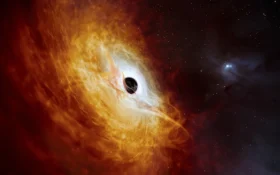
Astronomers have discovered what may be the brightest object in the universe, a quasar with a black hole at its heart growing so fast that it swallows the equivalent of a sun a day.
The record-breaking quasar shines 500 trillion times brighter than our sun. The black hole powering this distant quasar is more than 17 billion times more immense than our sun, an Australian-led team reported Monday in the journal Nature Astronomy.
While the quasar resembles a mere dot in images, scientists envision a ferocious place.
The rotating disk around the quasar’s black hole — the luminous swirling gas and other matter from gobbled-up stars — is like a cosmic hurricane.
“This quasar is the most violent place that we know in the universe,” lead author Christian Wolf of Australian National University said in an email.
The European Southern Observatory spotted the object, J0529-4351, during a 1980 sky survey, but it was thought to be a star. It was not identified as a quasar — the extremely active and luminous core of a galaxy — until last year. Observations by telescopes in Australia and Chile’s Atacama Desert clinched it.
“The exciting thing about this quasar is that it was hiding in plain sight and was misclassified as a star previously,” Yale University’s Priyamvada Natarajan, who was not involved in the study, said in an email.
These later observations and computer modeling have determined that the quasar is gobbling up the equivalent of 370 suns a year — roughly one a day. Further analysis shows the mass of the black hole to be 17 to 19 billion times that of our sun, according to the team. More observations are needed to understand its growth rate.
The quasar is 12 billion light-years away and has been around since the early days of the universe. A light-year is 5.8 trillion miles.
The Associated Press contributed to this article.