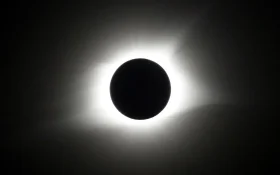
On April 8, a rare total solar eclipse will plunge parts of North America into darkness for almost 4 1⁄2 minutes. The moon will completely block the sun’s light along a narrow path from Buffalo to Dallas.
An estimated 44 million people live inside the 115-mile wide path of totality. The eclipse will allow millions to witness the spectacular cosmic event without traveling far, NASA Eclipse Program Manager Kelly Korreck told the Associated Press.
New Trump Bombshell [Sponored]
As the moon lines up directly between Earth and the sun, day will suddenly turn to night for communities along the path. Fifteen U.S. states fall in the path, with population centers cities like Indianapolis and Little Rock plunged into darkness.
Even locations outside the path of totality – like the Pacific Northwest – will experience a partial eclipse, with the moon obscuring a portion of the visible sun.
Thanks to a cosmic coincidence, the moon will be at its closest point to Earth the day prior, making it appear slightly bigger in the sky. This results in a longer than usual total eclipse duration of up to 4 minutes, 28 seconds.
The extended darkness offers more time for safe viewing. Outside totality, however, specialized solar glasses must be worn at all times to avoid eye damage from the sun’s rays. In other words, regular sunglasses won’t cut it, and it’s safe to remove eyewear only during the period of totality, when the sun is 100% obscured.
To celebrate the rare alignment, events like star parties, yoga sessions, music festivals and more will unfold across eclipse-affected regions. Museums, parks, stadiums and theaters host everything from weddings to astronomy lectures. NASA itself plans rocket launches timed with the phenomenon.
North America won’t see another similar coast-to-coast total solar eclipse until 2045. And most locations only experience totality once every 400-1000 years. So for many areas, this will likely be a once-in-a-lifetime spectacle.
The 2024 phenomenon culminates a series of eclipses visible from the U.S and Canada over recent years. A total eclipse dimmed skies from Oregon to South Carolina as recently in 2017.
But the 2024 event stands out for its duration, path and number of Americans impacted. The extended totality phase offers more opportunity for science experiments and photography. It also enables more viewers across densely populated regions to marvel as daylight transiently disappears.
To best appreciate the rare occurrence, anticipating crowds should prepare travel plans well in advance. Public safety authorities in eclipse-affected regions have readied awareness campaigns about safe viewing guidance.
After 2024, the next American total solar eclipses arrive in 2033 and 2044, visible only in Alaska and parts of the Great Plains respectively. So for most U.S. residents, the upcoming spectacle represents a once-in-a-lifetime experience right in their own backyard.
The Associated Press contributed to this article.