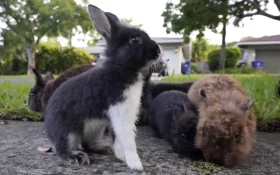
When Alicia Griggs steps outside her suburban Fort Lauderdale home, Florida’s latest invasive species comes a-hoppin’ down the street: lionhead rabbits.
The bunnies, which sport an impressive flowing mane around their heads, want the food Griggs carries. But she also represents their best chance of survival and moving where this domesticated breed belongs: inside homes, away from cars, cats, hawks, Florida heat and possibly government-hired exterminators.
Griggs is spearheading efforts to raise the $20,000 to $40,000 it would cost for a rescue group to capture, neuter, vaccinate, shelter and then give away the estimated 60 to 100 lionheads now populating Jenada Isles, an 81-home community in Wilton Manors.
They are descendants of a group a backyard breeder illegally let loose when she moved away two years ago.
“They really need to be rescued. So we’ve tried to get the city to do it, but they’re just dragging their feet,” Griggs said. “They think that if they do that, then they’ll have to get rid of iguanas and everything else that people don’t want around.”
Monica Mitchell, whose East Coast Rabbit Rescue would likely lead the effort, said capturing, treating and finding homes for them “is not an easy process.” Few veterinarians treat rabbits and many prospective owners shy away when they find out how much work the animals require. Griggs agreed.
“People don’t realize they’re exotic pets and they’re complicated. They have a complicated digestive system and they have to eat a special diet,” said Griggs, a real estate agent. “You can’t just throw any table scraps at them.”
Wilton Manors is giving Griggs and other supporters time to raise money and relocate the rabbits rather than exterminate them, even though the city commission voted in April to do just that after receiving an $8,000 estimate from a trapping company.
The vote came after some residents complained the lionheads dig holes, chew outdoor wiring and leave droppings on sidewalks and driveways. City commissioners also feared the rabbits could spread into neighboring communities and cities and become a traffic hazard if they ventured onto major streets.
“The safety of this rabbit population is of utmost importance to the City, and any decision to involve ourselves will be certain to see these rabbits placed into the hands of people with a passion to provide the necessary care and love for these rabbits,” Police Chief Gary Blocker said in a statement.
The Florida Fish and Wildlife Conservation Commission, which often culls invasive animals, has told the city it will not intercede. The rabbits pose no immediate threat to wildlife.
Lionhead rabbits aren’t the only invasive species causing headaches or worse for Floridians. Burmese pythons and lionfish are killing off native species. Giant African snails eat stucco off homes and carry human disease. Iguanas destroy gardens. Like the Wilton Manors lionhead rabbits, those populations all started when people illegally turned them loose.
But unlike those species, Florida’s environment is not friendly to lionheads. Instead of the 7 to 9 years they live when properly housed, their lives outdoors are nasty, brutal and shortened.
The lionheads’ heavy coat makes them overheat during Florida summers and their lack of fear makes them susceptible to predators. Munching on lawns is not a healthy diet. Their illnesses go untreated. They need owners.
“Domesticated (rabbits) released into the environment are not equipped to thrive on their own,” said Eric Stewart, executive director of the American Rabbit Breeders Association. He said the breeder who released them should be prosecuted, a path the city has not pursued.
The Wilton Manors colony survives and grows only because lionheads breed like the rabbits they are, with females birthing litters of two-to-six offspring every month, starting when they are about 3 months old.
On a recent morning in Jenada Isles, clutches of two to 10 bunnies dotted the streets and lawns, the bravest hopping up to residents and visitors in search of treats.
A large group of rabbits gathered on the driveway of Gator Carter, who puts out food for them. He said the lionheads bring the neighborhood joy, and his two young grandchildren love giving them carrots.
“People drive by, stop, love ’em, feed ’em,” Carter said. “They don’t bother me. We have a couple Airbnbs on the island here and the people (guests) are just amazed that the rabbits come right up to them.”
But Jon King said he wants the rabbits gone soon. They dig in his yard and he spent $200 repairing his outdoor lights after they damaged the wiring. He bought rabbit repellent, but that didn’t work, and his little dog doesn’t scare them: “He’s their best friend.”
“Every morning, I get up and first thing I do is cover up the holes and chase them out of the backyard. I like them, I just wish they would go somewhere else,” King said. “Rescue would be great.”
The Associated Press contributed to this article.