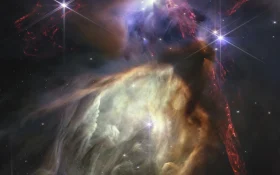
The Webb Space Telescope is marking one year of cosmic photographs with one of its best yet: the dramatic close-up of dozens of stars at the moment of birth.
NASA unveiled the latest snapshot Wednesday, revealing 50 baby stars in a cloud complex 390 light-years away. A light-year is nearly 6 trillion miles (9.7 trillion kilometers).
The region is relatively small and quiet yet full of illuminated gases, jets of hydrogen and even dense cocoons of dust with the delicate beginnings of even more stars.
All of the young stars appear to be no bigger than our sun. Scientists said the breathtaking shot provides the best clarity yet of this brief phase of a star’s life.
“It’s like a glimpse of what our own system would have looked like billions of years ago when it was forming,” NASA program scientist Eric Smith told The Associated Press.
Smith pointed out that the starlight visible in the image actually left there 390 years ago. On Earth in 1633, Italian astronomer Galileo Galilei went on trial in Rome for saying that the Earth revolved around the sun. The Vatican in 1992 acknowledged Galileo was wronged.
This cloud complex, known as Rho Ophiuchi, is the closest star-forming region to Earth and is found in the sky near the border of the constellations Ophiuchus and Scorpius, the serpent-bearer and scorpion. With no stars in the foreground of the photo, NASA noted, the details stand out all the more. Some of the stars display shadows indicating possible planets in the making, according to NASA.
It “presents star birth as an impressionistic masterpiece,” NASA Administrator Bill Nelson said in a tweet.
Webb — the largest and most powerful astronomical observatory ever launched into space — has been churning out cosmic beauty shots for the past year. The first pictures from the $10 billion infrared telescope were unveiled last July, six months after its liftoff from French Guiana.
It’s considered the successor to the Hubble Space Telescope, orbiting Earth for 33 years. A joint NASA-European Space Agency effort, Webb scans the universe from a more distant perch, 1 million miles (1.6 million kilometers) away.
Still ahead for Webb: Astronomers hope to behold the earliest stars and galaxies of the universe while scouring the cosmos for any hints of life on planets outside our solar system.
“We haven’t found one of them yet,” Smith said. “But we’re still only one year into the mission.”
The Associated Press contributed to this article.