DNA is all around us — even in the air we breathe. Now scientists have found that air quality monitoring stations — which pull in air to test for pollution — also pick up lots of DNA that can reveal what plants and animals have been in the area.
The method could help solve the tricky challenge of keeping tabs on biodiversity, according to a study published Monday in the journal Current Biology.
The findings suggest that biodiversity data has been collected “on massive scales literally for decades — and nobody’s noticed,” said study author Elizabeth Clare, a biologist at Canada’s York University.
As animals and plants go through their life cycles, they leave little bits of themselves in the environment — scales, fur, feathers, pollen — which carry their genetic signature.
Scientists have long known that this kind of environmental DNA floats around in water, and have used it to track what species are swimming in lakes and rivers. But it’s been harder to get a genetic picture of what’s roaming around on land, said Kristine Bohmann, who studies environmental DNA at the University of Copenhagen and was not involved with the latest study.
In 2021, both Bohmann and Clare worked on similar projects to see whether they could pull animal DNA from thin air. After setting up vacuum pumps in local zoos, the teams were able to sequence DNA from dozens of species.
“You can actually, in a Ghostbuster kind of way, vacuum DNA out of the air,” Bohmann said.
Then researchers wanted to try that on a bigger scale.
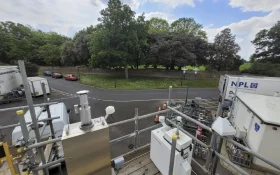
For this latest study, Clare and her team tested air filters from two monitoring stations, one in London and one in Scotland, which are part of a national network to test for pollution.
After extracting DNA from pieces of the filter disks, the scientists were able to identify more than 180 different kinds of plants and animals, said study author Joanne Littlefair, a biologist at Queen Mary University of London.
The filters picked up on a wide range of wildlife, including grasses, fungi, deer, hedgehogs and songbirds — along with “the ubiquitous pigeon,” Littlefair said.
Now, the team hopes that this method could track ecosystems all over the world. Even though biodiversity decline is a global issue, it’s hard to test for on a large scale, Clare said.
And it’s an easy lift to use systems that are already in place, pointed out James Allerton, an air quality scientist at the UK’s National Physical Laboratory. Many countries have networks set up to monitor air quality, and some of them store their old filters for years or even decades — an archive that could help show how ecosystems have changed over time.
More research is needed to see if the data from these filters can show real biodiversity trends over time, said Fabian Roger, who has been working on a similar project at ETH Zurich in Switzerland. But it’s exciting that an existing system could be “co-opted” to monitor wildlife, he wrote in an email.
The Associated Press contributed to this article.